


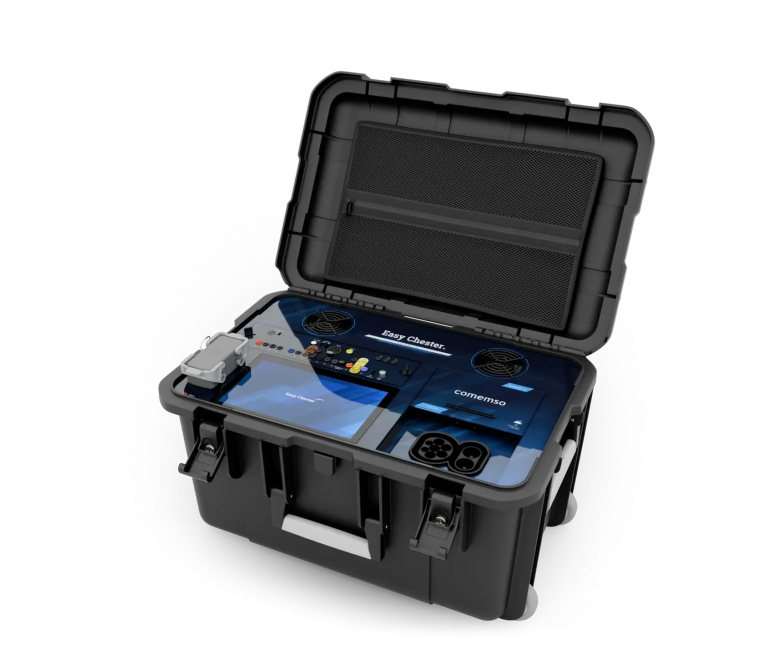

Easy Chester Ultimate-EVSE tester for AC/DC chargers: one guided pass from safety check to report
An EVSE tester checks whether a charging station is safe and charges correctly. Easy Chester Ultimate does both, at AC chargers and DC fast chargers. It takes the role of the vehicle, with real charging current at DC. It checks electrical safety on the grid and vehicle side and documents the results in one report – instead of an electric vehicle plus separate instruments.
This product is temporarily out of stock. You may opt-in our waiting list and we'll notify you once the product is restocked.
Product Overview
Charges like a car – then tests what a car can’t
Ultimate starts a charging session the way a typical EV does, so the station starts charging as it would for a customer’s car. Then it checks what no car can: protective conductor, insulation, RCD and loop impedance on the grid side; insulation, residual voltage and isolation monitoring at the connector – plus defined faults on CP, PP and PE. One guided pass, one PDF report.

Product Features

The 10.1-inch touchscreen keeps test selection, active step, measured value and next action on one screen. Ultimate detects the inserted charging plug, checks its internal modules at start-up and runs the whole workflow on the device itself. Built-in videos and a digital manual explain each check in several languages.

Test results in the PDF report
One PDF report for every inspected charger
Station, performed checks, measured values and the result PASSED or FAILED – documented for handover, maintenance or repair.
Ultimate UI. RCD test example

Example RCD test screen before test completion, showing the selected check, measurement fields and progress in context.
Safety first. Then function.
Test protective measures on the grid side and at the EV interface
With the comISO option, the electrical safety checks run in the same guided workflow as the charging test.


Supported charging interfaces and communication
EV charger tester for AC wallboxes and DC fast chargers
Europe, North America and Asia require different connectors and protocol combinations. We configure Ultimate by region, charging standard, safety scope and extension requirement.

One system for commissioning and service
Handover, maintenance, service and repair
When technicians repeat the same test process, they can compare results across locations and service cases.

Controlled behaviour and documented checks
Real EV, test adapter or Ultimate – what each can show
A charging session with a real vehicle documents how that pair charged under the observed conditions. A controlled test system adds repeatable safety checks, fault scenarios and documented results.

Datasheets
Video
FAQ
What is an EVSE tester?
An EVSE tester checks whether a charging station is safe and charges correctly. It takes the role of the vehicle, starts a charging session and tests the protective measures on the grid side and at the connector. Easy Chester Ultimate does this at AC and DC chargers – the safety checks as an option – and documents the results in a PDF report.
EVSE tester, EV charger tester or test adapter – what is the difference?
EVSE tester and EV charger tester name the same device class: a tester that takes the role of the vehicle at the charging station. A test adapter is simpler. It simulates the vehicle at the low level of IEC 61851-1 and so starts an AC charging session. Many adapters do not measure themselves – then you need an oscilloscope, or you judge by whether the station charges. At a DC charger, the station only switches on DC after the vehicle has communicated over PLC (DIN 70121 or ISO 15118). That needs a tester such as Easy Chester Ultimate.
Which standards does an EVSE tester cover?
That depends on the device and its options. Easy Chester Ultimate supports IEC 61851-1, SAE J1772, SAE J3400, DIN 70121 and CHAdeMO up to version 2.0. ISO 15118-2 with EIM runs at AC and DC; ISO 15118-20 is planned for Q1/2027. The optional safety checks follow VDE 0100-600, VDE 0413, VDE 0113-1 and VDE 0122-1. Ultimate checks function and safety in the field – conformance test cases run on EVCA.
What are the best tools for testing EV charging stations?
A system that combines electrical safety testing, AC and DC charging communication, controlled EV simulation, reproducible fault tests and a report – from a manufacturer-independent maker, so every charger brand gets the same checks. By task: Micro for AC installation, Ultimate for AC and DC, Easy Chester EOL for production, Calimera for meter calibration, EVCA for the lab.
Can Easy Chester Ultimate test AC and DC charging stations?
Yes. The configuration options include AC, CCS 1, CCS 2, NACS and CHAdeMO. We define the exact connector combination, protocol version and regional release for the delivered system.
Can it test without a real electric vehicle?
Yes. Ultimate takes the role of the vehicle, so the same charging, safety and fault scenarios run at every station – without depending on the state of a production vehicle.
Is Easy Chester Ultimate a standards-conformance tester?
No. Ultimate is an AC/DC installation tester for functional, load and electrical safety checks. For standards-conformance test cases covering IEC 61851-1, DIN 70121, ISO 15118, SAE J1772 or CHAdeMO, select the matching EVCA configuration.
Does a function test on a 400 kW HPC charging station verify its full rated power?
No. Station rating and test load are separate values. Ultimate checks charging function, communication and electrical safety at a defined operating point; see test loads and options. A full-power test needs equipment rated for the intended voltage, current, power and duration, plus defined acceptance criteria.
Which emulation voltage does a test of an 800 V charging station require?
Ultimate represents 400 V and 800 V vehicle technology at approximately 330 V and 660 V. Check whether this operating point, the connector and the protocol configuration fit the station and test task. The measurement range of 0–1,000 V is not an emulation range; for other emulation voltages, see EVCA Flex operating limits.