


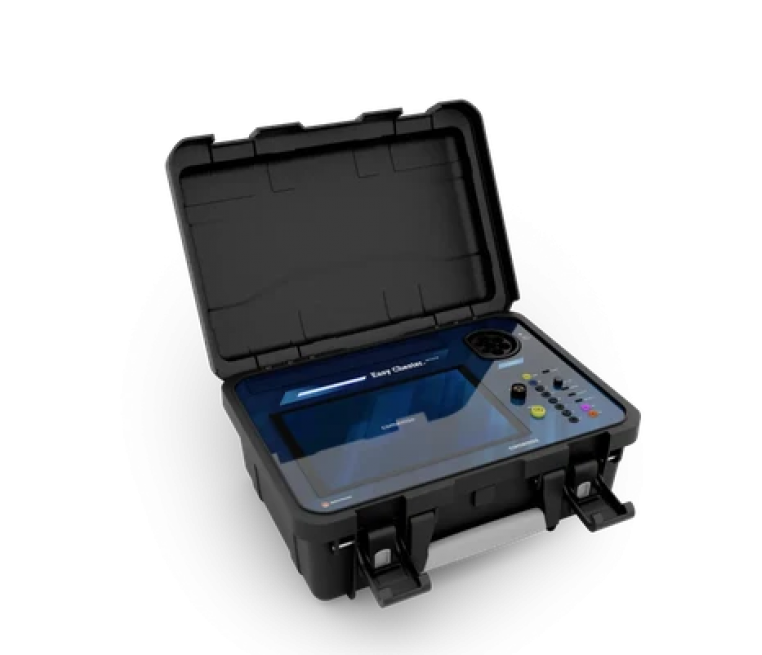

Easy Chester Micro-Test wallboxes and AC chargers with one instrument instead of two
Testing an AC charger used to take two instruments: an installation tester for the protective measures and an adapter box for the charging function, with re-cabling in between. Easy Chester Micro combines both. This wallbox tester guides you step by step on its touchscreen and produces a test report for every charging point. Connect once and leave the charging point with a test report.
This product is temporarily out of stock. You may opt-in our waiting list and we'll notify you once the product is restocked.
Product Overview
Charging function and protective measures in one pass
Micro checks whether the charger releases charging correctly and, with the safety option, measures the protective measures of the installation – without switching between two instruments. Station, configuration and results go into one test report for handover, maintenance and proof of repair.
Product Features
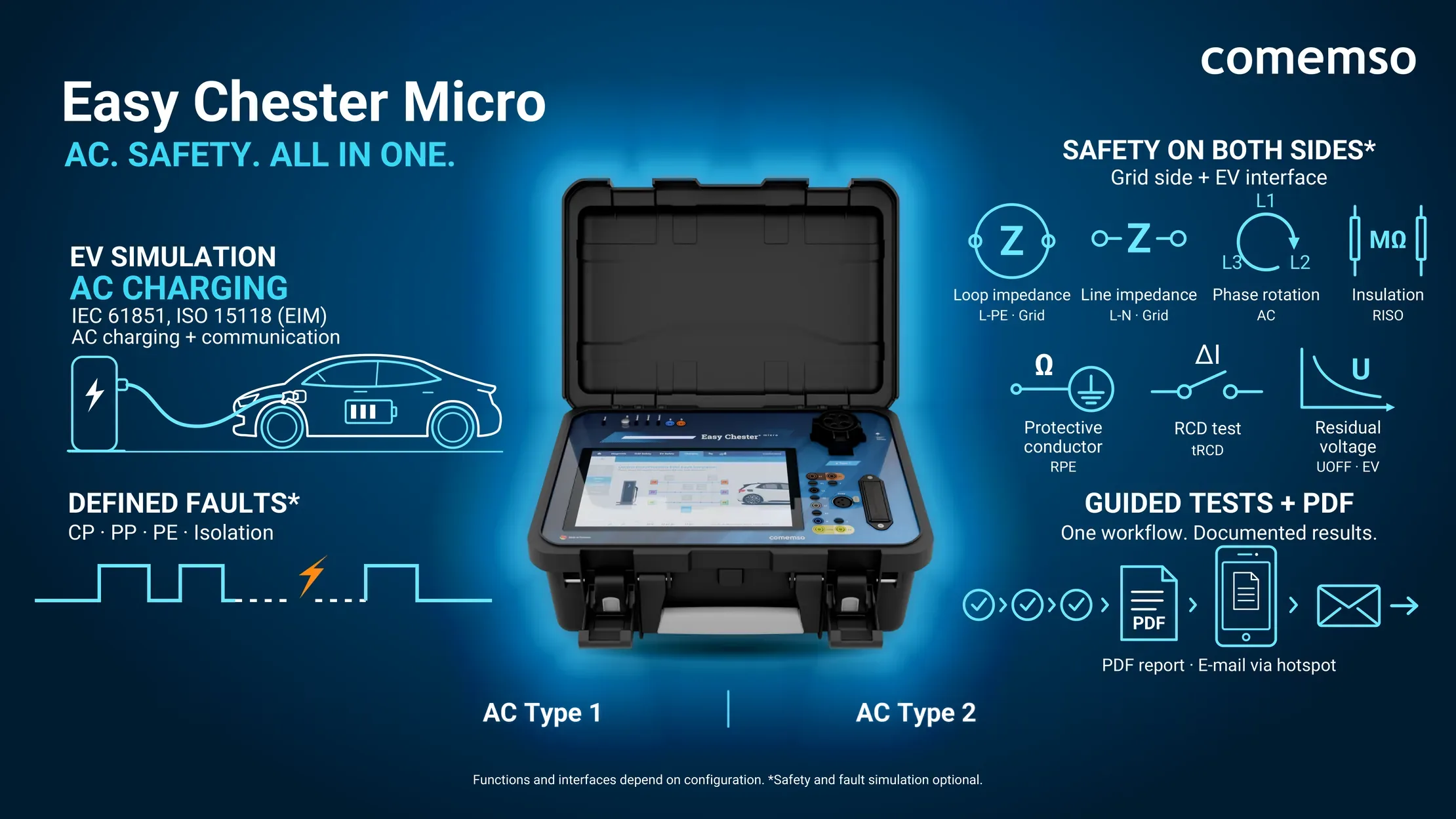
Charging function: Micro takes the role of the vehicle
Micro measures the CP voltage, the PWM duty cycle and the PP values (voltage and resistance). When the charger closes its AC contactors, Micro measures the voltage on the phases. If it is present, the charger has released charging – that is the PASS of the charging-function test. As an option, Micro simulates faults (PE break, CP and PP short circuit, PP break) and checks whether the charger stops the session.
Electrical safety on the grid and vehicle side (option)
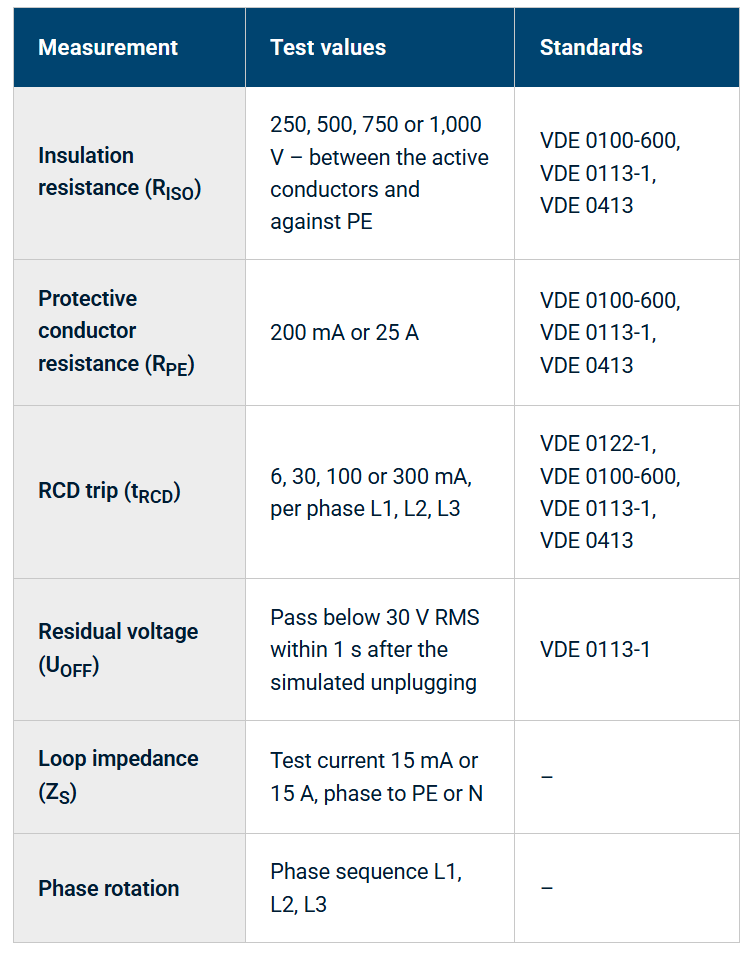
On the grid side, Micro measures insulation resistance, protective conductor resistance, RCD trip (tRCD), loop impedance and phase rotation; on the vehicle side, insulation resistance, protective conductor resistance, RCD trip, residual voltage and phase rotation. Micro assesses the protective measures separately from the charging function: a charger that charges is not necessarily safe.
Test values and standards (safety option)
Periodic inspection and proof after repairs
After repairs, changes and during periodic inspection, repeat the affected tests in the same guided workflow. Inspection intervals follow the applicable requirements and the site’s maintenance plan.
Communication to ISO 15118
Micro also tests the charging communication
Micro establishes ISO 15118-2 communication itself, without an external protocol converter. The test report shows whether the PLC connection between vehicle and charger works.1 AFIR requires this communication at AC and DC charging points. More on the standard in the ISO 15118 guide.
Available now
ISO 15118-2 with EIM authentication
Charging is authorised via EIM (External Identification Means), i.e. an external identification such as an RFID card or an app.
Available now
Connection setup and attenuation in the report
The test report records the ISO 15118-3 connection setup (SLAC) with the attenuation value. It also lists every communication step and the MAC address of the charger’s PLC interface.
The attenuation value describes signal loss during connection setup. An unusually high value can point to an impaired signal path, for example crosstalk instead of a direct connection to the PLC hardware. Read together with the communication sequence and the test setup, it leads to the cause; on its own it proves neither correct wiring nor crosstalk.
The instrument
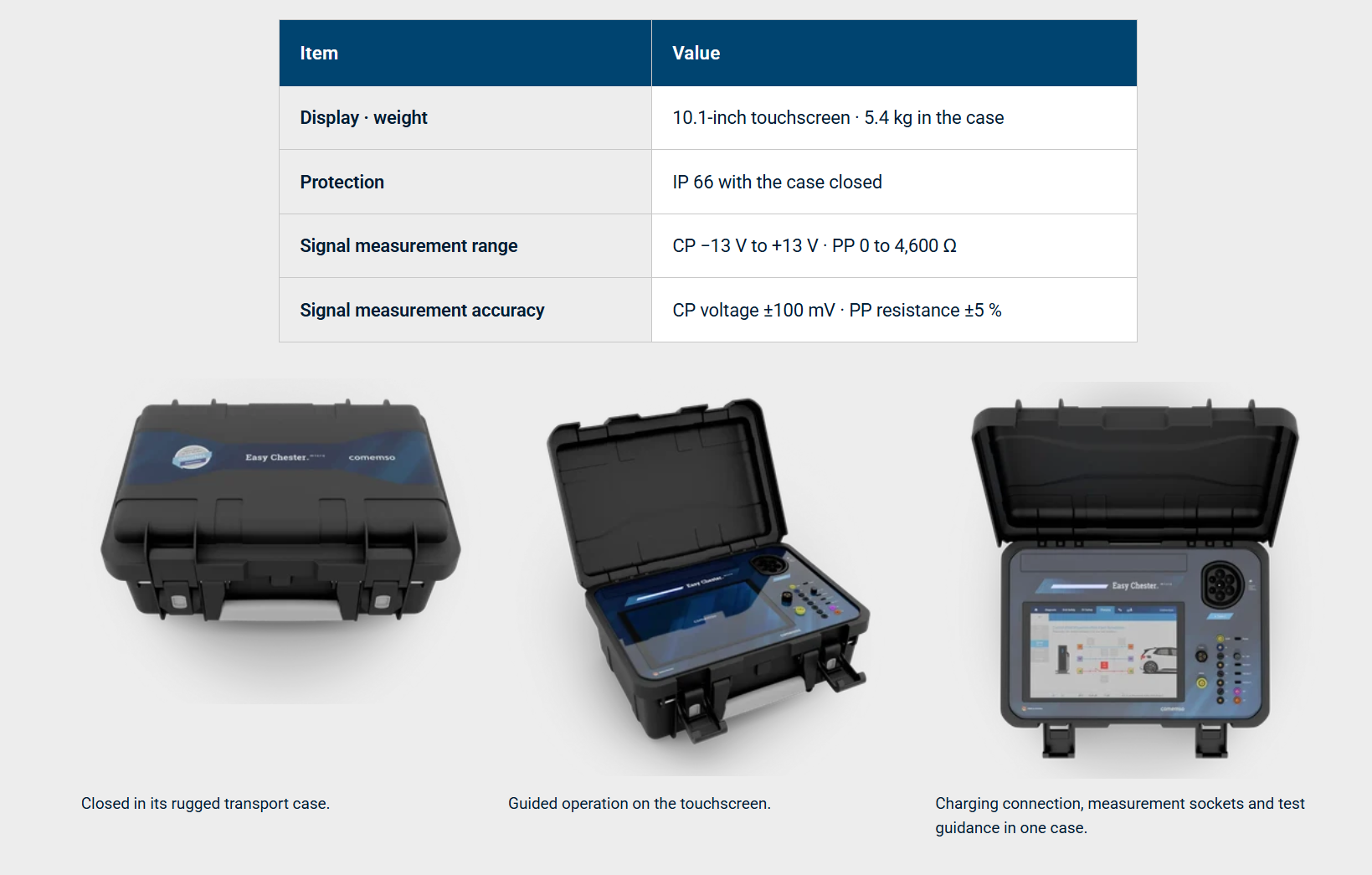
Carried to the charging point, guiding you through the test
Power comes via USB-C, a 12 V car adapter or a power bank; updates and remote support run over a mobile hotspot.
Datasheets
FAQ
What is an EVSE tester?
An EVSE tester checks whether a charging station is safe and charges correctly. It takes the role of the vehicle, starts a charging session and tests the protective measures on the grid side and at the connector. Easy Chester Ultimate does this at AC and DC chargers – the safety checks as an option – and documents the results in a PDF report.
EVSE tester, EV charger tester or test adapter – what is the difference?
EVSE tester and EV charger tester name the same device class: a tester that takes the role of the vehicle at the charging station. A test adapter is simpler. It simulates the vehicle at the low level of IEC 61851-1 and so starts an AC charging session. Many adapters do not measure themselves – then you need an oscilloscope, or you judge by whether the station charges. At a DC charger, the station only switches on DC after the vehicle has communicated over PLC (DIN 70121 or ISO 15118). That needs a tester such as Easy Chester Ultimate.
Which standards does an EVSE tester cover?
That depends on the device and its options. Easy Chester Ultimate supports IEC 61851-1, SAE J1772, SAE J3400, DIN 70121 and CHAdeMO up to version 2.0. ISO 15118-2 with EIM runs at AC and DC; ISO 15118-20 is planned for Q1/2027. The optional safety checks follow VDE 0100-600, VDE 0413, VDE 0113-1 and VDE 0122-1. Ultimate checks function and safety in the field – conformance test cases run on EVCA.
What are the best tools for testing EV charging stations?
A system that combines electrical safety testing, AC and DC charging communication, controlled EV simulation, reproducible fault tests and a report – from a manufacturer-independent maker, so every charger brand gets the same checks. By task: Micro for AC installation, Ultimate for AC and DC, Easy Chester EOL for production, Calimera for meter calibration, EVCA for the lab.
Can Easy Chester Ultimate test AC and DC charging stations?
Yes. The configuration options include AC, CCS 1, CCS 2, NACS and CHAdeMO. We define the exact connector combination, protocol version and regional release for the delivered system.
Can it test without a real electric vehicle?
Yes. Ultimate takes the role of the vehicle, so the same charging, safety and fault scenarios run at every station – without depending on the state of a production vehicle.
Is Easy Chester Ultimate a standards-conformance tester?
No. Ultimate is an AC/DC installation tester for functional, load and electrical safety checks. For standards-conformance test cases covering IEC 61851-1, DIN 70121, ISO 15118, SAE J1772 or CHAdeMO, select the matching EVCA configuration.
Does a function test on a 400 kW HPC charging station verify its full rated power?
No. Station rating and test load are separate values. Ultimate checks charging function, communication and electrical safety at a defined operating point; see test loads and options. A full-power test needs equipment rated for the intended voltage, current, power and duration, plus defined acceptance criteria.
Which emulation voltage does a test of an 800 V charging station require?
Ultimate represents 400 V and 800 V vehicle technology at approximately 330 V and 660 V. Check whether this operating point, the connector and the protocol configuration fit the station and test task. The measurement range of 0–1,000 V is not an emulation range; for other emulation voltages, see EVCA Flex operating limits.